Evidence reviewed to Aug 2026
How Long Botox and Filler Results Really Last, Study by Study
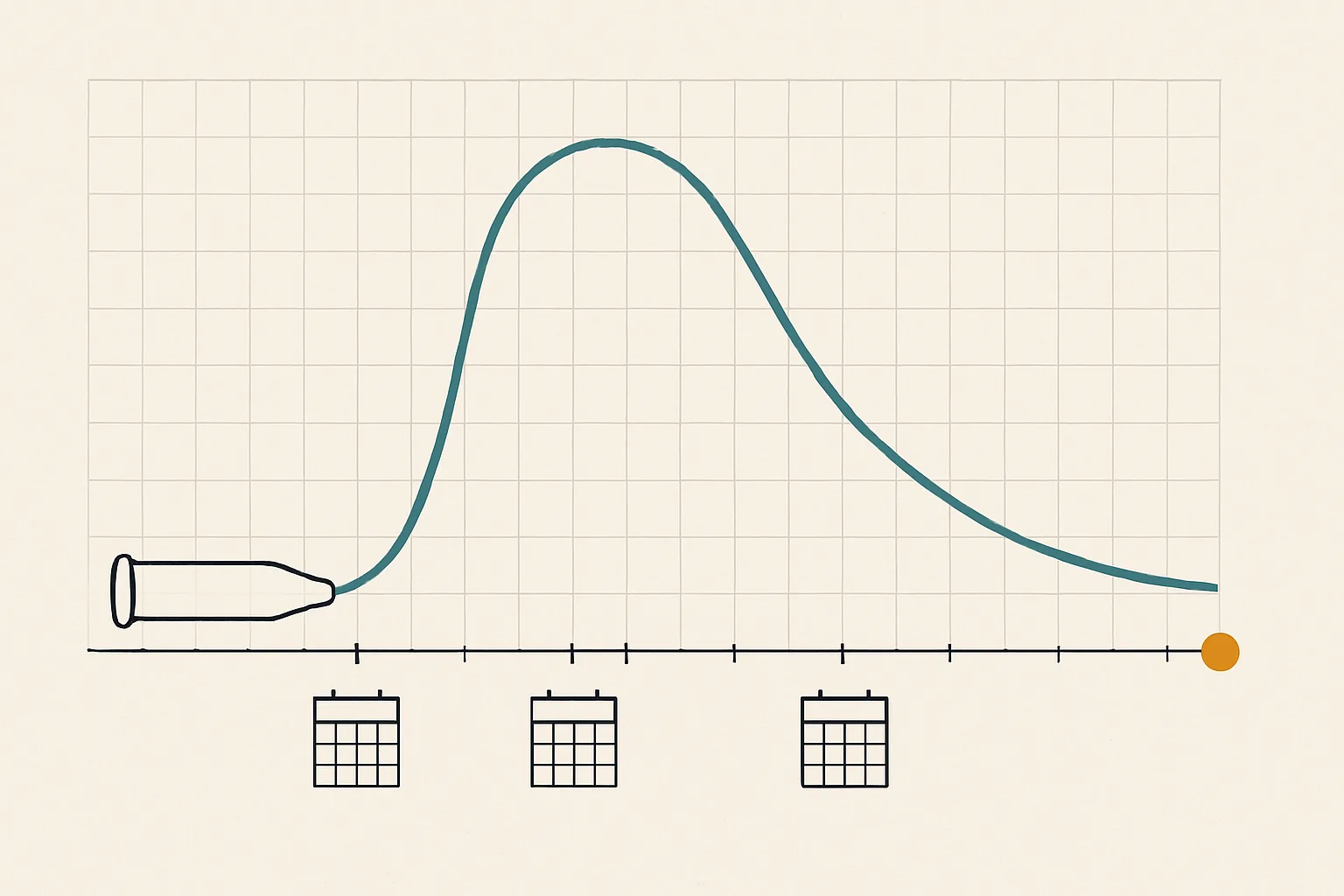
The short answer. Botulinum toxin softens frown lines for a median of about 120 days — roughly four months in the pivotal trials, not the year some marketing implies. HIGH · FDA label + RCTs Hyaluronic-acid fillers typically last 6–12 months, with a few products labeled longer, and they share one safety feature the others do not: they can be dissolved on demand. HIGH · FDA + labeling Collagen-stimulating fillers build slowly and last longer, but they cannot be reversed. MODERATE · labeling How long a result lasts on you, and whether any of this is appropriate for you at all, is a decision for a licensed clinician — this page reports what the studies measured, not what you should do.
“How long does it last?” is the question that decides the real price of an aesthetic treatment, because everything here is temporary and everything recurs on a schedule. The trouble is that two very different numbers get quoted for the same treatment: the duration a manufacturer is allowed to market, and the duration a randomized trial actually measured. This page puts both side by side, product by product, so a reader can tell which is which — and then does the maintenance arithmetic honestly, using the American Society of Plastic Surgeons' own average fees. Nobody at this publication received or performed any of these treatments; every number below is attributed to the source that produced it.
Why marketing numbers and trial numbers differ
When a brand says a result lasts “up to” a certain time, three things are usually happening at once. First, “up to” is a best case, not a typical case — it describes the longest responders, not the median patient. Second, the endpoint the trial chose shapes the headline. The pivotal botulinum-toxin studies measured glabellar-line severity at 30 days and tracked the return of the line afterward; a study that reports when most patients relapse produces a shorter, more honest number than one that reports the last patient to relapse. Third, a duration approved for one product at one dose in one area does not transfer to another brand, dose, or part of the face. The dependable way to read any duration claim is to ask which trial produced it and against what endpoint — which is exactly what the tables below record.
The toxin ledger
All the cosmetic neuromodulators are botulinum toxin type A, and their durations cluster tightly because the biology is shared: the toxin temporarily blocks the nerve-to-muscle signal, the nerve terminals recover, and the muscle moves again. Peak effect for onabotulinumtoxinA develops over 30 to 60 days, and the median duration of response for dynamic glabellar lines in the initial studies was 120 days — about four months — per a review of the onabotulinumtoxinA program [2]; the FDA prescribing information states the duration of effect for glabellar lines as approximately 3–4 months [1]. The other type-A toxins cluster in the same range under their own FDA labeling: Dysport's label says the clinical effect “may last up to four months” [9], Xeomin's directs retreatment no sooner than every three months [10], and Jeuveau's is class-typical at 3–4 months with retreatment no sooner than every three months [11]. The one product marketed for a distinctly longer effect is Daxxify, which uses a peptide stabilizer; in its SAKURA trials the median duration of none-or-mild glabellar-line severity was about 24 weeks (~6 months) — a figure that rests on the manufacturer's own program and is graded accordingly [12].
| Product (molecule) | Duration reported | Source | Grade |
|---|---|---|---|
| Botox Cosmetic (onabotulinumtoxinA) | Duration of effect ~3–4 months (FDA label); median 120 days and peak at 30–60 days in the initial studies | FDA label [1] + onabotA review [2] | HIGH · FDA label + RCT |
| Dysport (abobotulinumtoxinA) | “May last up to four months” | Dysport FDA label [9] | HIGH · FDA label |
| Xeomin (incobotulinumtoxinA) | ~3 months (retreat no sooner than every 3 months) | Xeomin FDA label [10] | HIGH · FDA label |
| Jeuveau (prabotulinumtoxinA-xvfs) | ~3–4 months (class-typical; retreat no sooner than every 3 months) | Jeuveau FDA label [11] | MODERATE · label + class-typical |
| Daxxify (daxibotulinumtoxinA-lanm) | ~4–6 months (marketed; median ~24 weeks in SAKURA trials, peptide stabilizer) | Daxxify FDA label [12] | MODERATE · maker's trials |
| Letybo (letibotulinumtoxinA) | ~3–4 months (class-typical; FDA-approved 2024) | Letybo FDA label [13] | MODERATE · class-typical |
The practical reading: for a standard cosmetic dose, a result that lasts about a third to half a year is the expectation the evidence supports. An advertisement promising “a year of Botox” is describing something other than what the glabellar-line trials measured. What botulinum toxin does, how well, and its risks are covered in more depth in the botulinum toxin article.
The filler ledger
Fillers vary far more than toxins, because “filler” covers three chemically different materials that behave differently and last differently. The most important consumer distinction is not duration at all — it is reversibility, which is why it gets its own column. Hyaluronic-acid fillers can be dissolved with the enzyme hyaluronidase if something goes wrong or a result is unwanted. The collagen-stimulating fillers cannot: once placed, the option is to wait, sometimes for a year or more.
| Material (examples) | Duration reported | Reversible? | Grade |
|---|---|---|---|
| Hyaluronic acid — Juvederm, Restylane, RHA, Belotero, Versa | Typically 6–12 months; some (e.g. Juvederm Voluma in the cheek) cited at 18–24 months | Yes — dissolvable with hyaluronidase | HIGH · FDA + labeling |
| Calcium hydroxylapatite — Radiesse | ~12–18 months; also stimulates collagen | No — not dissolvable by hyaluronidase | MODERATE · labeling |
| Poly-L-lactic acid — Sculptra | A collagen stimulator; result builds over several sessions and can last up to ~2 years | No — not reversible on demand | MODERATE · labeling |
A few notes on reading this table. Hyaluronic acid adds volume directly, so the effect is visible immediately and fades gradually as the gel is metabolized [3]. Calcium hydroxylapatite (Radiesse) lasts longer and also prompts the body to make collagen. Poly-L-lactic acid (Sculptra) is not really a volumizer at all — it is a collagen stimulator whose result appears over weeks and multiple sessions rather than at once, which is why its “duration” is measured differently from a gel filler [3]. The longer-lasting materials trade that longevity for the thing HA offers: an undo button. The FDA regulates soft-tissue fillers as medical devices and maintains the approved-product list these durations come from [3].
Longer is not automatically better. A filler that lasts two years is also a filler you live with for two years if the placement or the amount is not what you wanted, because the collagen stimulators cannot be dissolved. Duration and reversibility are a trade-off to weigh with a licensed clinician for your specific goals — not a ranking where the biggest number wins.
What shortens or extends results
Two influences on duration are well supported; a third is widely assumed and less firmly established. Keeping them separate matters, because providers sometimes present the assumed one as fact.
- Dose and product (known). Duration is tied to how much active product is placed and which product it is. Daxxify's longer marketed duration, for instance, is a formulation-and-dose story, not a difference in how any one patient's body behaves [12]. This is a clinician's dosing decision and is out of scope to prescribe here.
- Treatment area (known). The same material can last different lengths of time in different locations — a filler in a low-movement area behaves differently from one in a highly mobile area, and the labeled durations above are area-specific for that reason (the cheek figure for Juvederm Voluma is not the figure for a lip) [3].
- Individual metabolism and activity (assumed). It is commonly claimed that faster metabolism, intense exercise, or age shortens results. This is plausible and often repeated, but it is not established by strong trial evidence the way dose and product are, so treat any specific “it lasts less if you work out” number as an estimate, not a measurement.
The maintenance math
Because results recur on a schedule, the honest cost of any of these treatments is annual, not per-visit. The arithmetic is simple: sessions per year multiplied by the price per session. For the price, this page uses the American Society of Plastic Surgeons' national average physician fees — a published, attributable reference point. Read them with a large caveat, stated below the table.
| Treatment | Typical interval | Sessions / year | ASPS avg. fee | Illustrative annual fee |
|---|---|---|---|---|
| Botulinum toxin | ~3–4 months [1] | ~3 | $435 [5] | ~$1,305 |
| Hyaluronic-acid filler | ~6–12 months [3] | ~1–2 | $715 [6] | ~$715–$1,430 |
| Non-HA / stimulator filler | ~12–24 months [3] | ~0.5–1 | $901 [6] | ~$450–$901 |
| Lip augmentation with filler | ~6–12 months [3] | ~1–2 | $743 [6] | ~$743–$1,486 |
Read the “annual fee” column as a floor, not a quote. The ASPS figures are physician-fee national averages only: they exclude the product itself, the facility, anesthesia, and any add-ons, so they understate the all-in price a consumer actually pays, and local per-unit or per-syringe pricing runs higher [5][6]. The point of the table is not the exact dollar amount — it is the shape of the commitment: a treatment that fades in four months is a three-times-a-year expense for as long as you want to maintain the look, and a filler that lasts a year is a smaller-but-recurring one. Multiply by the number of areas treated, and the recurring nature is the real cost, not the sticker price of a single visit. These volumes are enormous, which is part of why the numbers are worth getting right: ASPS counted 9,883,711 neuromodulator treatments and 5,331,426 hyaluronic-acid filler patients in 2024 [7].
“Preventative Botox” in your twenties
A common marketing pitch is that starting botulinum toxin early — in your twenties, before lines set — heads off wrinkles later. Here the honest position is narrow but clear. Whether early, ongoing treatment changes the long-term trajectory of facial lines is not well established by strong evidence; it is a reasonable-sounding hypothesis that has not been settled the way the short-term efficacy has. What is known follows directly from the drug's mechanism: stopping causes no permanent change. The toxin's effect is temporary, so when treatment ends, the nerve-to-muscle signal returns and the muscle moves again as it did before — there is no evidence that stopping leaves the face worse than never having started. That means “preventative” use is a spending-and-schedule decision far more than a medical necessity, and a licensed clinician is the right person to discuss whether it makes sense for you.
What we don't know
Reviewed to August 2026.
- Long-term repeated treatment. The trials that establish how long a single round lasts are short — weeks to a few months. Rigorous data on what many years of repeated toxin or filler treatment does over the long horizon remain limited, a gap a Cochrane systematic review of botulinum toxin for facial lines reflects in its cautious framing [4].
- Head-to-head duration. Most duration figures come from each product's own program against a placebo, not from independent trials comparing brands on the same patients. Daxxify's longer-duration claim in particular rests largely on the manufacturer's trials [12].
- Individual variation. The metabolism, activity, and lifestyle factors people cite to explain why a result faded fast are plausible but not well quantified, so any precise personal-duration promise should be read as an estimate.
Risks do not disappear because the effect is temporary
A short duration is sometimes offered as reassurance — if you dislike the result, it wears off. That is true for the look, but not for the risks, which belong on this page alongside the numbers. Botulinum toxin carries a class boxed warning for the distant spread of toxin effect: symptoms such as trouble swallowing, speaking, or breathing that can appear hours to weeks after injection and can be life-threatening [1]. For dermal fillers, the FDA identifies the most serious risk as unintentional injection into a blood vessel, causing vascular occlusion — with reported complications including tissue necrosis, vision abnormalities including blindness, and stroke [8]. Reversibility helps with an unwanted result; it does not undo a vascular event. These risks, and how a complication is managed, are matters for a licensed clinician.
Questions to ask a licensed clinician
Duration is the right thing to interrogate in a consultation, because it drives both the schedule and the true cost. A good provider welcomes these questions.
- How long do you expect this to last on me, and is that number from the product's trials or from your own experience? (The toxin trials' median was about 120 days [2].)
- Is this filler reversible with hyaluronidase, or is it one of the ones I would have to wait out?
- How many sessions per year should I plan for, and what is the itemized cost of each — product, facility, and fee, not just the headline?
- If I stop after a year or two, does anything about my face stay changed, or does it simply return to baseline?
- For a longer-lasting product: what happens, and what are my options, if I do not like the result?
- What are the warning signs of a serious problem after injection, and who do I call, day or night?
Not medical advice. This page is informational only and is not a substitute for a consultation with a licensed clinician. Duration on any individual, candidacy, dosing, product choice, and the management of any complication are individual medical decisions and are out of scope here.
References
- FDA, BOTOX Cosmetic (onabotulinumtoxinA) for injection — prescribing information: the label states the duration of effect for glabellar lines as approximately 3–4 months and reports glabellar-line severity reduced for up to 120 days in the pivotal studies, and it carries the boxed warning on distant spread of toxin effect. accessdata.fda.gov (2018 label PDF).
- “Treatment of glabellar lines with Botox (onabotulinumtoxinA): development, insights, and impact,” Medicine (Baltimore), 2023 — reports peak effect at 30–60 days and a median duration of response of 120 days for dynamic glabellar lines. Covers onabotulinumtoxinA only. PubMed 37499082.
- FDA, “FDA-Approved Dermal Fillers” and “Dermal Fillers (Soft Tissue Fillers)” — device classification and approved-product list underlying HA (6–12 months, reversible with hyaluronidase), calcium hydroxylapatite, and poly-L-lactic acid durations. fda.gov — Dermal Fillers.
- Camargo CP, et al. “Botulinum toxin type A for facial wrinkles.” Cochrane Database of Systematic Reviews, 2021, CD011301.pub2 — short-term efficacy established; adverse effects probably more common than placebo; long-term, repeated-treatment evidence limited. cochranelibrary.com.
- American Society of Plastic Surgeons, botulinum toxin cost (national average physician fee, $435). plasticsurgery.org.
- American Society of Plastic Surgeons, dermal filler cost (national average physician fee: HA $715; non-HA $901; lip augmentation with filler $743). plasticsurgery.org.
- American Society of Plastic Surgeons, 2024 Plastic Surgery Statistics Report (neuromodulator treatments 9,883,711; hyaluronic-acid filler patients 5,331,426). plasticsurgery.org.
- FDA, “Dermal Fillers (Soft Tissue Fillers)” — most serious risk is unintentional intravascular injection causing vascular occlusion, with reported tissue necrosis, vision abnormalities including blindness, and stroke. fda.gov — Dermal Fillers.
- FDA, DYSPORT (abobotulinumtoxinA) for injection — prescribing information: “The clinical effect of DYSPORT may last up to four months”; retreat no more frequently than every three months. accessdata.fda.gov (2023 label PDF).
- FDA, XEOMIN (incobotulinumtoxinA) for injection — prescribing information: for glabellar lines, retreatment no sooner than a minimum of three months. accessdata.fda.gov (2018 label PDF).
- FDA, JEUVEAU (prabotulinumtoxinA-xvfs) for injection — prescribing information: glabellar-line efficacy assessed at Day 30; retreatment no more frequently than every three months. accessdata.fda.gov (2019 label PDF).
- FDA, DAXXIFY (daxibotulinumtoxinA-lanm) for injection — prescribing information: SAKURA glabellar-line trials followed subjects for at least 24 weeks; the maker reports a median duration of none-or-mild severity of about 24 weeks (~6 months). accessdata.fda.gov (2022 label PDF).
- FDA, LETYBO (letibotulinumtoxinA-wlbg) for injection — prescribing information (BLA 761225, approved 2024); an FDA-approved type-A neuromodulator for glabellar lines, class-typical duration. accessdata.fda.gov (2024 label PDF).
Update log · Aug 2026 — first published.