Evidence reviewed to Aug 2026
Laser Hair Removal: Permanent Reduction, Not Permanent Removal — the Numbers Behind the Promise
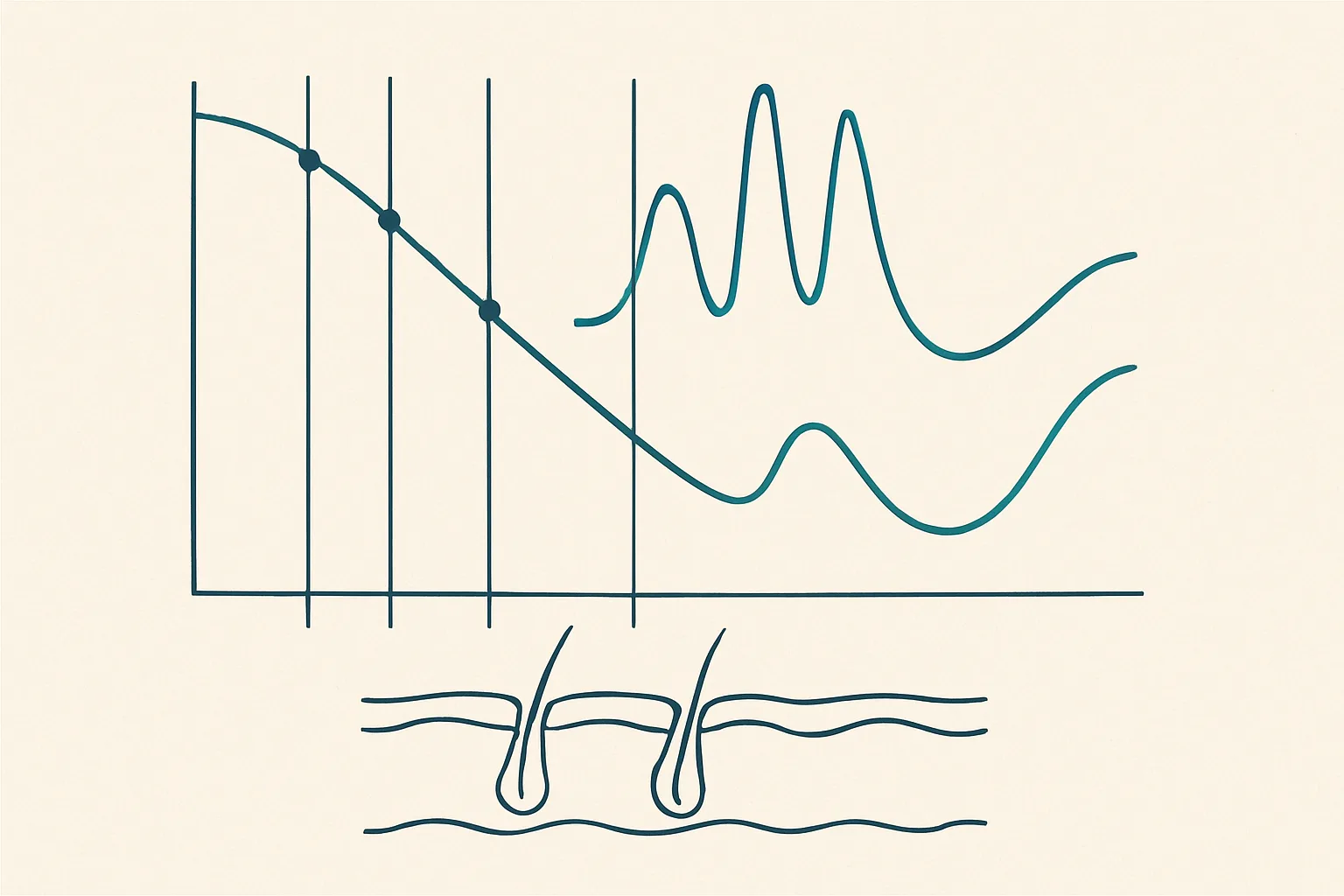
The short answer. Laser hair removal reduces unwanted hair; it does not permanently remove it. The U.S. Food and Drug Administration clears these devices for permanent hair reduction — which its own clearances define as a long-term, stable reduction in the number of hairs that regrow — not the permanent removal of all hair. HIGH · FDA A meta-analysis of laser trials measured roughly 40–60% long-term reduction after three sessions, depending on the device. HIGH · meta-analysis Your skin tone changes both which laser is appropriate and how much risk it carries. “Hair-free forever” is a marketing phrase, not a study result. Which device, how many sessions, and whether you are a candidate at all are decisions for a licensed clinician, not for a web page.
Laser and light-based hair removal sits inside the broad category of skin treatments the American Society of Plastic Surgeons counted at 3,112,056 procedures in 2024 [5]. It is heavily advertised, and the advertising tends to promise more than the evidence delivers. This page separates the two: what the mechanism can and cannot do, what the trials actually measured, why a device that is right for one person is dangerous for another, and where the risks sit. Every number is tied to the source that produced it. Nobody at this publication received or performed any of this; it is informational only.
How does laser hair removal actually work?
The principle is called selective photothermolysis. In plain terms: the laser fires light at a wavelength that the pigment in the hair — melanin — absorbs strongly. The absorbed light turns to heat, and that heat damages the follicle and the stem cells in the bulge region that regenerate the hair, while the surrounding skin, which absorbs less of that wavelength, is relatively spared [3]. The whole approach depends on contrast: dark hair against lighter skin gives the light a clear target. That single fact explains most of what follows, including why the treatment works better on some people than others and why it is riskier on darker skin.
It also explains why one session is never enough. Hair grows in cycles, and a follicle is only vulnerable to the laser while it is in its active growth phase; follicles that are dormant on the day of treatment are not effectively targeted. Because only a fraction of hairs are actively growing at any one time, a course of treatments spaced over weeks is needed to catch more follicles in the vulnerable phase — which is why the trial evidence below is built on three sessions, not one [2].
How much hair does it actually remove?
This is where the marketing and the measurements diverge. The FDA's cleared indication for these devices is permanent hair reduction, which its clearances define as a long-term, stable reduction in the number of hairs that regrow — assessed at 6, 9, and 12 months after a course of treatment — and which does not mean the permanent removal of all hair [1]. The regulator built the honest word into the clearance itself.
The size of that reduction was measured directly. A meta-analysis of hair-removal laser trials found the following reductions after three sessions, assessed at least six months after treatment [2]:
| Laser | Wavelength | Reduction at ≥6 months | Evidence |
|---|---|---|---|
| Diode | 810 nm | 57.5% | HIGH · meta-analysis [2] |
| Alexandrite | 755 nm | 54.7% | HIGH · meta-analysis [2] |
| Ruby | 694 nm | 52.8% | HIGH · meta-analysis [2] |
| Nd:YAG | 1064 nm | 42.3% | HIGH · meta-analysis [2] |
Read the table honestly and it says: after three sessions, roughly four to six of every ten hairs are gone in a durable way, not ten of ten. That is a genuinely useful result — but it is a reduction, and the hair that remains is often finer and lighter rather than absent. Marketing language, including at times on this very domain during its earlier life as a medical spa, has framed the outcome as being “hair-free” permanently. The measurements do not support that framing, and neither does the FDA's own wording [1]. This site publishes the number, not the promise.
The percentages also come with maintenance attached. Because the reduction is partial and some follicles recover, periodic maintenance sessions are commonly needed to hold a result over years. How many, and how often, is individual, and is a question for the clinician performing the course — not something a study can prescribe for your face and hair.
Why does skin type change the device — and the danger?
Clinicians describe skin tone on the Fitzpatrick scale, a six-point classification from type I (very fair, always burns) to type VI (deeply pigmented, never burns). It matters here because the same melanin that makes the hair a good target also lives in the skin, and in darker skin there is far more of it in the epidermis to absorb the laser's energy by mistake — which is how burns and pigment changes happen.
The wavelength is the lever that manages this. Shorter wavelengths — ruby at 694 nm, alexandrite at 755 nm, diode at 810 nm — are absorbed strongly by melanin and are favored for lighter skin with fine, dark hair, where the contrast is high and epidermal risk is low. The longer Nd:YAG wavelength at 1064 nm is absorbed less by melanin and penetrates deeper, which makes it the safer choice for darker skin types (Fitzpatrick IV–VI): it can still reach the follicle while sparing more of the heavily pigmented epidermis [3]. The trade-off is visible in the table above — Nd:YAG's measured reduction (42.3%) is the lowest of the four, the price of firing a wavelength that melanin absorbs less avidly [2].
The practical consequence for a consumer is blunt: the wrong device on the wrong skin causes burns and lasting pigment change. A provider who offers laser hair removal on deeply pigmented skin should be able to tell you which device they are using and why it is appropriate for your skin type. An operator who treats every skin the same way with the same setting is a risk, not a bargain.
What are the risks, honestly ranked?
Compared with the injectable treatments, laser hair removal is a relatively low-complication procedure in trained hands — but “relatively low” is not “none,” and the risks scale sharply with operator skill and skin type. The ladder below runs from common and minor to the outcomes worth taking seriously.
| Frequency | What can happen | Source |
|---|---|---|
| Common, transient | Redness, swelling, and discomfort around the follicles right after treatment, usually settling within hours to days | Laser-hair-removal literature [3] |
| Less common | Transient hyperpigmentation (darkening) or hypopigmentation (lightening) of the skin; most reported cases resolve without permanent effect | Laser-hair-removal literature [3] |
| Avoidable but real | First-degree burns, especially when the device or setting is mismatched to skin type. These serious events are uncommon in controlled use: a trial of a combined alexandrite/Nd:YAG laser across Fitzpatrick I–VI, over 12 months, reported only minimal, transient adverse events | Alexandrite/Nd:YAG trial [3] |
Two things are worth pulling out of that table. First, the low complication rate — minimal, transient adverse events in the combined alexandrite/Nd:YAG trial cited, across the full Fitzpatrick I–VI range [3] — was achieved with appropriate devices used competently; it is not a property of “lasers” in the abstract, and it does not transfer to a mismatched device on unprepared skin. Second, the pigment changes and burns cluster in exactly the situation the previous section describes: a wavelength or fluence wrong for the skin type. The risk is real, and it is largely an operator-and-equipment problem rather than an inherent one — which is precisely why who treats you matters as much as what device they own.
After a treatment, when to seek care
Some redness and swelling around the treated follicles is expected and usually brief. Contact your treating clinician if you develop blistering, an open burn, spreading pain, signs of infection (increasing warmth, pus, fever), or a change in skin color that does not settle. Burns and pigment changes are the recognized serious end of the risk ladder for this procedure [3], and they are managed by a licensed clinician — not self-treated. This box is information, not a diagnosis.
Who is even allowed to fire the laser?
A medical laser is a prescription-level device, and in many states operating one is a delegated medical act that must happen under a licensed prescriber's supervision — but the specifics vary widely from state to state, from who may hold the handpiece to how much supervision is required [6]. There is no single national answer, and a glossy clinic is not evidence of a lawful one. Before booking, it is fair — and this site would say essential — to ask who will actually perform the treatment, what their license is, and who the supervising physician is. The companion articles on who is legally allowed to treat you and how to verify a license in the public record lay out the mechanics; they apply to energy devices as much as to needles.
The blunt version: a laser's marketing name and its advertised results are not a substitute for an experienced, properly supervised operator matching the right device to your skin. The device brochure describes the best case in ideal hands; the person holding the handpiece determines the case you actually get.
What does it cost?
The American Society of Plastic Surgeons reports a national average physician fee of roughly $697 per laser hair removal session [4]. Read that figure the way you should read every cost on this site. It is a physician-fee average, not an all-in price — it does not settle how many sessions a durable result will take, and a course is several sessions plus maintenance, not one. Total cost therefore depends on the body area, your hair and skin, and the number of treatments the reduction requires. The number is a published reference point, not a quote, and the cheapest per-session price is not the metric that matters if the device is wrong for your skin.
Questions to ask a licensed clinician
A good provider welcomes these; evasion is itself an answer. Print or screenshot this list and take it to the consultation.
- Which laser will you use on me — diode, alexandrite, ruby, or Nd:YAG — and why is it the right one for my skin type?
- What is my Fitzpatrick skin type, and how does that change the device, the setting, and my risk of burns or pigment change?
- Realistically, how much reduction should I expect, and after how many sessions? (The trials measured roughly 40–60% after three [2].)
- How many maintenance sessions will I likely need to hold the result, and at what interval?
- Who will actually operate the laser, what is their license, and who is the supervising physician? (How to check.)
- What are the warning signs of a burn or pigment problem afterward, and who do I contact if one appears?
- What is the total expected cost across the full course, not just the price of one session?
What we don't know
Reviewed to August 2026.
- Very long-term durability. The strongest reduction figures are measured at least six months out [2]. How the reduction holds over many years, and exactly how much maintenance each person needs, is individual and less well quantified than the short-to-medium-term numbers.
- Light or grey hair. Because the method depends on melanin in the hair as its target [3], blonde, red, grey, and white hairs offer the laser little to absorb. How well any device performs on low-pigment hair is much weaker ground than the results for dark hair on lighter skin.
- At-home devices. The trial figures in this article come from clinical lasers used in supervised settings. Consumer-grade home devices are a different category, and this page makes no claim about their effectiveness or safety.
Not medical advice. This page is informational only and is not a substitute for a consultation with a licensed clinician. Candidacy, device selection, settings, and the management of any complication are individual medical decisions and are out of scope here.
References
- U.S. Food and Drug Administration, 510(k) clearance K180353 (diode laser hair-removal device) — cleared indication “hair removal, permanent hair reduction,” where “permanent hair reduction is defined as the long-term, stable reduction in the number of hairs regrowing when measured at 6, 9, and 12 months after the completion of a treatment regime.” The clearance is for reduction, not removal. accessdata.fda.gov/cdrh_docs.
- Meta-analysis of hair-removal laser trials — long-term reductions after three sessions, assessed at ≥6 months: diode 57.5%, alexandrite 54.7%, ruby 52.8%, Nd:YAG 42.3%. PubMed 18027066.
- Ugonabo, Chapas & Rohrer, “Use of Simultaneous Emission of Nd:YAG and Alexandrite Lasers in BLEND Mode for Hair Removal and Permanent Hair Reduction,” Lasers in Surgery and Medicine (2026) — a 53-subject clinical study, Fitzpatrick I–VI, five sessions with 12-month follow-up: selective photothermolysis, alexandrite (755 nm) and Nd:YAG (1064 nm) wavelengths and their skin-type suitability, and minimal, transient adverse events. doi:10.1002/lsm.70130, onlinelibrary.wiley.com.
- American Society of Plastic Surgeons, laser hair removal cost — national average of $697 (stated as only part of the total price, excluding other related expenses). plasticsurgery.org.
- American Society of Plastic Surgeons, 2024 Plastic Surgery Statistics Report — skin-treatment procedures (including laser hair removal, IPL, laser vein, and tattoo removal) totaling 3,112,056. plasticsurgery.org.
- American Med Spa Association and Quarles Law, med-spa scope-of-practice guidance — operating lasers as a delegated medical act under physician supervision, varying by state. americanmedspa.org.
Update log · Aug 2026 — first published.